
Do You Really Need ADAS Calibration After Auto Glass Repair? The Truth for Huntington Drivers
Picture this: You’re cruising down I-64, headed toward Barboursville for a quick errands run, when a stray rock kicked up by a construction truck smacks your windshield. That sickening crack is a sound every driver in Huntington, WV knows too well. At first, you think it’s just a nuisance: a trip to a collision repair shop to get the glass swapped out, and you’ll be back on the road.
But when you get the estimate, there’s a line item you didn't expect: ADAS Calibration.
Suddenly, a simple piece of glass feels a lot more complicated. You might find yourself asking, “Is this just an upsell? Do I really need to calibrate my car just because of a new windshield?” It’s a fair question. After all, twenty years ago, a windshield was just a windshield. Today, however, that glass is actually one of the most sophisticated safety components on your vehicle.
At The Otto Shop, we’ve seen the evolution of auto technology firsthand over our two decades in business. If you’re searching for auto glass repair near me, it’s vital to understand that modern safety hinges on more than just clear vision: it hinges on precision electronics.
Modern Windshields: They’re Not Just Glass Anymore
For generations, the windshield’s job was simple: keep the wind, rain, and bugs out of your face while providing structural support for the roof. While it still does those things, the glass in your modern sedan, SUV, or truck now serves as a high-tech housing for your car’s “eyes.”
Most vehicles manufactured in the last decade are equipped with Advanced Driver Assistance Systems (ADAS). These systems include features you likely rely on every day without even thinking about them:
- Lane Departure Warning: That little beep or vibration when you drift toward the shoulder on Route 60.
- Automatic Emergency Braking: The system that slams on the brakes if the car in front of you stops suddenly.
- Adaptive Cruise Control: The magic that keeps a safe distance from the car ahead while you’re driving through traffic.
- Forward Collision Warning: The alert that tells you a crash is imminent.
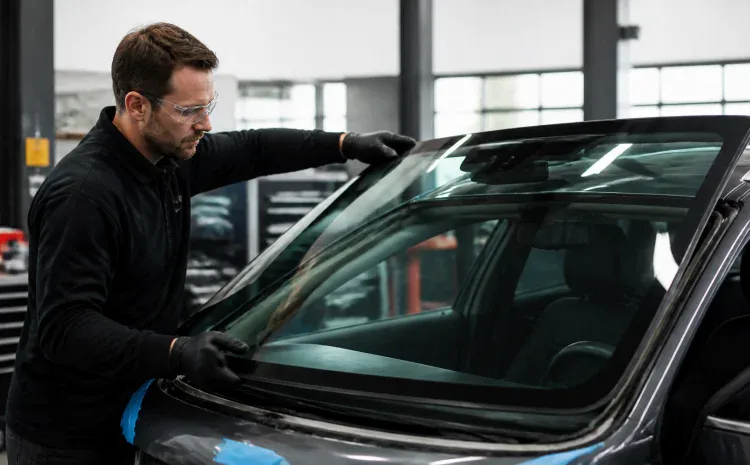
Where are the sensors for these systems? Most of them: specifically the forward-facing cameras: are mounted directly to the inside of your windshield, tucked behind the rearview mirror. When we perform auto glass repair or replacement, we have to detach these cameras and reattach them to the new glass. Even the tiniest shift in position: less than the width of a human hair: can throw the entire system out of whack.
The Scary Reality of Being "One Degree Off"
You might think, “If the camera is in roughly the same spot, isn't that good enough?”
In the world of automotive safety, "roughly" can be dangerous. Think about it like this: if you’re standing at a shooting range and your aim is off by just one millimeter at the barrel, you’ll miss the target by feet at fifty yards.
The same logic applies to your car's sensors. According to the Auto Glass Safety Council, if a camera's aim is off by just one degree, the collision avoidance system can be misaligned by about 8 feet at a distance of 100 feet.
Imagine you’re driving through a rainy Huntington evening. A car stalls in the middle of the road 100 feet ahead. Your Automatic Emergency Braking is designed to stop you just in time. But because your camera is off by that single degree, it thinks the car is 8 feet further to the right than it actually is. The system doesn't engage, or it engages too late. That’s the difference between a close call and a trip to a collision repair shop for major frame work.

Why You Won’t See a Warning Light
One of the biggest misconceptions we hear at our shop is: "If something was wrong, the dashboard light would come on, right?"
Unfortunately, that isn't always true. Your car’s computer knows if a sensor is unplugged or completely dead. However, it often doesn't know if the sensor is simply pointing in the wrong direction. The camera is still sending data, so the computer assumes the data is correct.
It’s a "quiet" failure. You might drive for weeks thinking your safety features are protecting you, only to find out they’re blind to the actual lane lines or obstacles in front of you. This is why finding a certified mechanic near me who understands the nuances of calibration is non-negotiable.
When is Calibration Absolutely Required?
While windshield replacement is the most common reason for ADAS calibration, it’s not the only one. For drivers in the Huntington area, you should consider a calibration check if:
- The Windshield is Replaced: Any time the glass comes out, the cameras must be recalibrated to the new optical properties of the glass.
- You’ve Had a Collision: Even a minor "fender bender" can jar the sensors or change the alignment of the vehicle's body.
- Suspension Changes: If you’ve leveled your truck or put on a lift kit, the "tilt" of the vehicle has changed, meaning the cameras are now looking at the ground or the sky instead of the road.
- A Fault Code Appears: If your "Lane Assist Unavailable" light does happen to pop up, it’s time for a professional look.
Why Huntington Drivers Trust The Otto Shop
When it comes to something as critical as your car’s "eyes," you want more than just a technician: you want someone who treats your vehicle like their own family’s car.
As a family-owned business with over 20 years of hands-on experience, we’ve seen the transition from carburetors to computer-guided safety suites. We don't just "swap glass." We ensure that every collision repair and mechanical service we perform meets the highest safety standards.
Specialized Equipment and Certified Expertise
Calibration isn't something you can do with a standard wrench and a screwdriver. It requires specialized "targets" and diagnostic software that talk directly to your car’s brain. There are two types of calibration we handle:
- Static Calibration: This happens inside our shop. We set up physical targets at specific heights and distances, and the car's computer "learns" its surroundings while parked.
- Dynamic Calibration: This involves driving the vehicle at specific speeds on well-marked roads (like the flat stretches around the Ohio River) so the camera can calibrate itself based on real-world lane markings.
We have the tools and the training to handle both, ensuring that when you leave our shop, your car is as safe as the day it rolled off the assembly line.
Does My Insurance Cover This?
The good news for Huntington residents is that most insurance companies recognize that ADAS calibration is a mandatory safety requirement, not an optional luxury. If your windshield replacement is being covered by insurance, the calibration is almost always included in that coverage.
We pride ourselves on providing transparent estimates. We’ll work with you to explain exactly what your car needs and why, so there are never any surprises when you pick up your keys.
Choosing the Right Team for Your Safety
At the end of the day, you have a choice. You can go to a high-volume glass "factory" that might skip the technical details, or you can choose a local team that understands the weight of the responsibility.
Your windshield is no longer just a window; it’s a critical component of a complex safety network. Skipping calibration might save a few dollars today, but it could cost far more in the long run if those safety systems fail when you need them most.
Whether you need a rock chip repaired, a full windshield replacement, or you’re looking for a certified mechanic near me for routine maintenance, we’re here to help. At The Otto Shop, we combine old-school craftsmanship with modern technology to keep Huntington families safe on the road.
Ready to ensure your vehicle is performing at its best? Don’t leave your safety to chance. Contact The Otto Shop today for a transparent estimate and expert service you can trust. Let’s get you back on the road with total peace of mind.
ADAS Calibration After Windshield Repair: Why Huntington Drivers Need It
Is ADAS calibration necessary? Learn why modern windshields require expert calibration in Huntington, WV to keep your safety sensors working correctly.